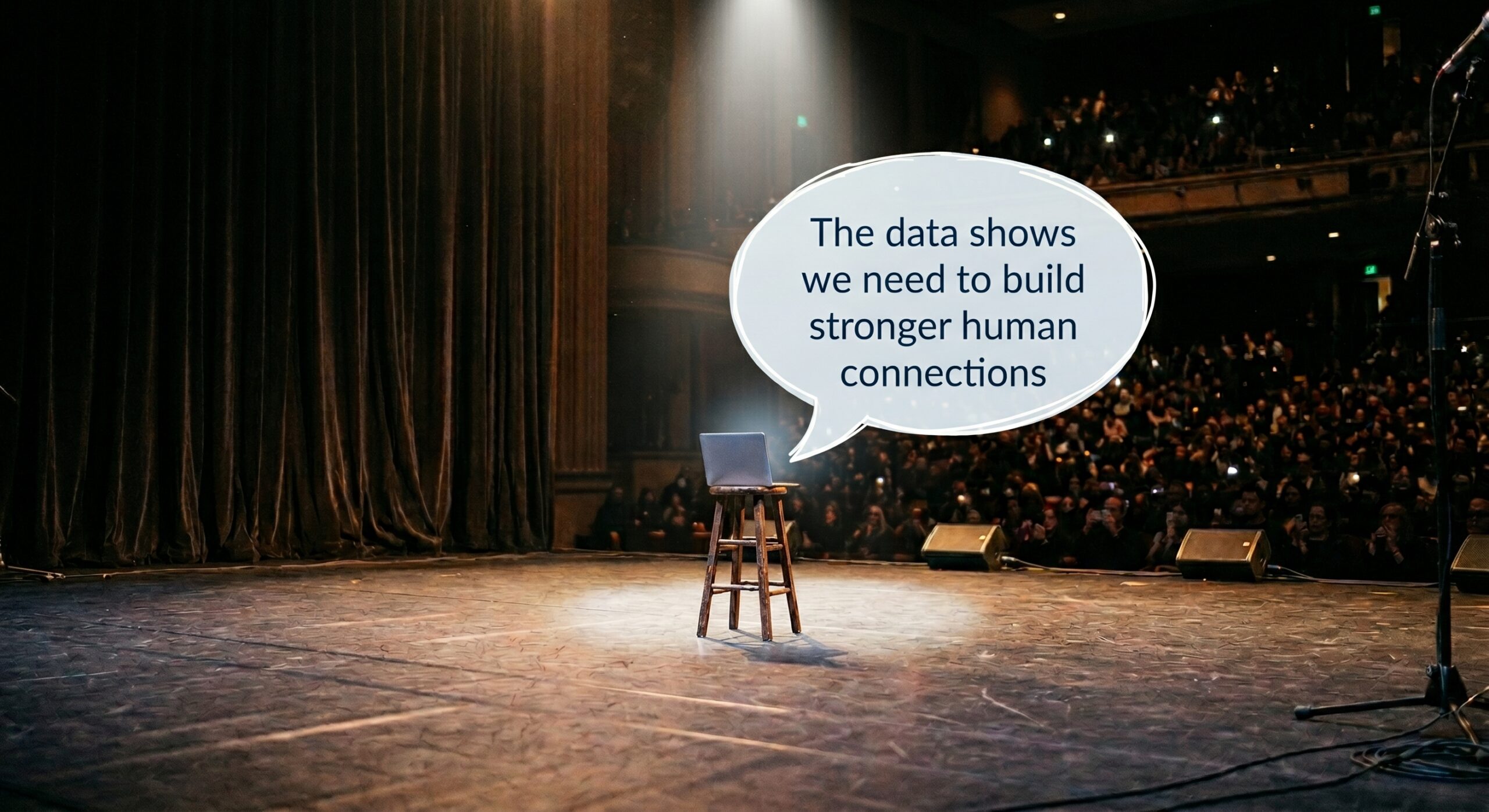


AI Can Generate Content. Humans Create Emotional Connection.
AI is changing the way presentations are built.
Ideas can be summarized in seconds. Research can be synthesized instantly. Slides can be generated faster than ever before. Outlines, headlines, transitions, and talking points — all available on demand.
And honestly?
Some of it is pretty good.
I use AI in my own work. Many of my clients do too. Used thoughtfully, it can dramatically accelerate parts of the presentation process.
But after coaching executives, keynote speakers, analysts, and leaders through high-stakes presentations, I’ve noticed something important:
AI can generate content.
Humans create emotional connections.
And those are not the same thing.
The difference becomes obvious the moment a speaker steps onto a stage.
Because audiences do not connect to perfectly structured information the way they connect to human presence.
They respond to tension, curiosity, humor, vulnerability, timing, pauses, stories, conviction, and emotional rhythm. They respond to the feeling that someone real is speaking to them.
That’s the part AI still struggles to create.
AI is excellent at producing polished-sounding language. The danger is that polished can quickly become predictable.
You can often feel it in presentations now. Everything is clear. Everything is organized. Everything is technically correct.
And somehow nothing is memorable.
Why?
Because emotional connection rarely comes from perfectly optimized wording.
It comes from humanity.
From the unexpected story. The off-the-cuff observation. The pause after a difficult question. The moment a speaker admits uncertainty. The laugh that wasn’t scripted. The tension before the insight lands.
Those moments cannot be manufactured entirely through prompts.
They come from lived experience, instinct, emotional intelligence, and presence.
Ironically, as AI-generated content becomes more common, these human elements become more valuable, not less.
Audiences are already becoming more sensitive to generic communication. They may not always know why something feels flat, but they feel it.
We are entering a strange moment where information is abundant, but genuine connection is becoming rare.
That changes the value of communication.
The presenters who stand out in the future will not necessarily be the ones with the most polished slides or the fastest AI workflows.
They’ll be the ones who know how to:
create tension,
tell meaningful stories,
read a room,
build anticipation,
simplify complexity,
and make audiences feel something.
AI can absolutely help you brainstorm. It can help you organize. It can help you draft. It can even help you rehearse.
But it should support your thinking, not replace your humanity.
The goal is not to sound more like AI.
The goal is to use AI while sounding even more human.
Because long after audiences forget the exact wording of a presentation, they remember how the speaker made them feel.
Related Articles
More insights to help you strengthen your communication.


“
It’s not about perfection.
It’s about showing up with clarity and confidence.
”
You have the expertise.
I help you deliver it.
They remember it.
 Got a presentation coming up?
Don't wait until the night before, show up prepared and polished